
Medicine River Luings belongs to Iain and Rowena Aitken. Iain emigrated to Canada in 2000 from southwest Scotland where his family had farmed beef cattle and sheep for eight generations. Along with his wife he spent 14 years ranching on the banks of the Medicine River, in the Leedale community west of Rimbey, Alberta. When reckless oilfield development involving fracking threatened our water supply we looked for a new property. In June 2015 we moved to our new location near Belmont in southwest Manitoba.
Our Ranch

Our owned land-base, in an ecosystem classified as “oak savanna”, is a mix of cropland, perennial pastures with areas of oak trees, bush and many cattail ringed sloughs and potholes. We grow annual crops for winter feed on around 10% of our acres but the remainder of the cropland has been sown back to perennial cover to restore fertility and depleted organic matter to the soil. We also rent additional pastures locally that are a mix of open pasture, bush and wetland wildlife habitat. Luing cows are ideally suited to utilising the high volume, low quality forage that grows on these wetland pastures and are a critical part of regenerating the habitat for the wildlife.

We operate a planned grazing system based on holistic management principles that minimize over-grazing and maximize soil, plant and water cycle health. These combined allow us to effectively double our effective rainfall which goes a long way to mitigating the drought risk in our unpredictable climate. To utilize the forage production effectively we typically move cattle onto fresh pasture every second day throughout the grazing season. Tame pastures with higher production potential might be grazed three times a year while the less productive acres are grazed only once.
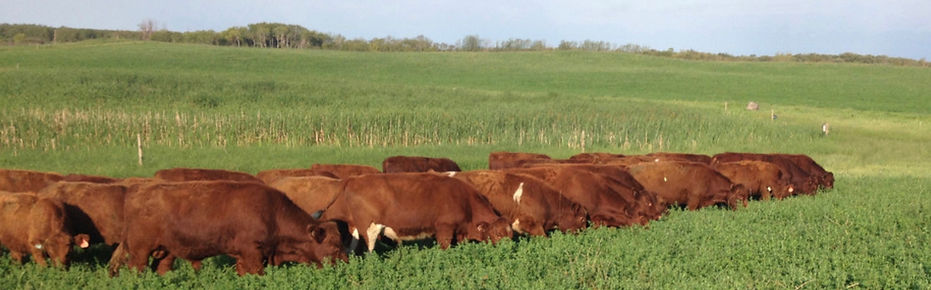
Permanent and temporary electric fences allow us to create an infinite number of pastures that are typically from one to two acres. Our grazing plan is complex due to the need to run single bull breeding pastures which necessitates us running eight or more different cattle groups at certain times of the grazing season. While this really is “management intensive” grazing the pay back is that we can easily produce twice as much grass as traditional set-stock ranching would produce off the same area.

One of the keys to utilizing our pastures in this more intensive manner has been water development. We have installed various summer-use pasture pipelines feeding both large tire waterers and smaller portable troughs depending on location. We also have several fenced off dugouts/ponds from which we solar pump water to troughs while preventing the cattle from contaminating the source. In addition to the summer water supply we have also developed fully winterized remote watering sources that allow us to feed cows out on the land versus having them confined to corrals.

Our cows begin grazing deferred forage (grown the previous year) in early April and this also provides a clean, dry bed for the cows to calve on and almost completely eliminates scours or illness in our young calves. The grazing season typically lasts through until mid or late November when we wean the calves and start feeding everything.

We grow much of our own winter feed - alfalfa/grass mixtures for hay or silage, corn silage and occasionally warm season annuals like millet for greenfeed. We also buy in cereal straw, hay and energy/protein supplements like wheat shorts and non-GMO canola meal as needed. During the coldest months of winter we feed the cows on the land that has the poorest fertility and lowest organic matter levels and this helps build up our soils. By using portable feed bunks, feed rings and windbreaks we can spread heavy applications of manure evenly across these fields.
